Insights · Ideas
Anthropic, Microsoft, and why biopharma is next.
Seeing disruption coming is not the same as being ready.
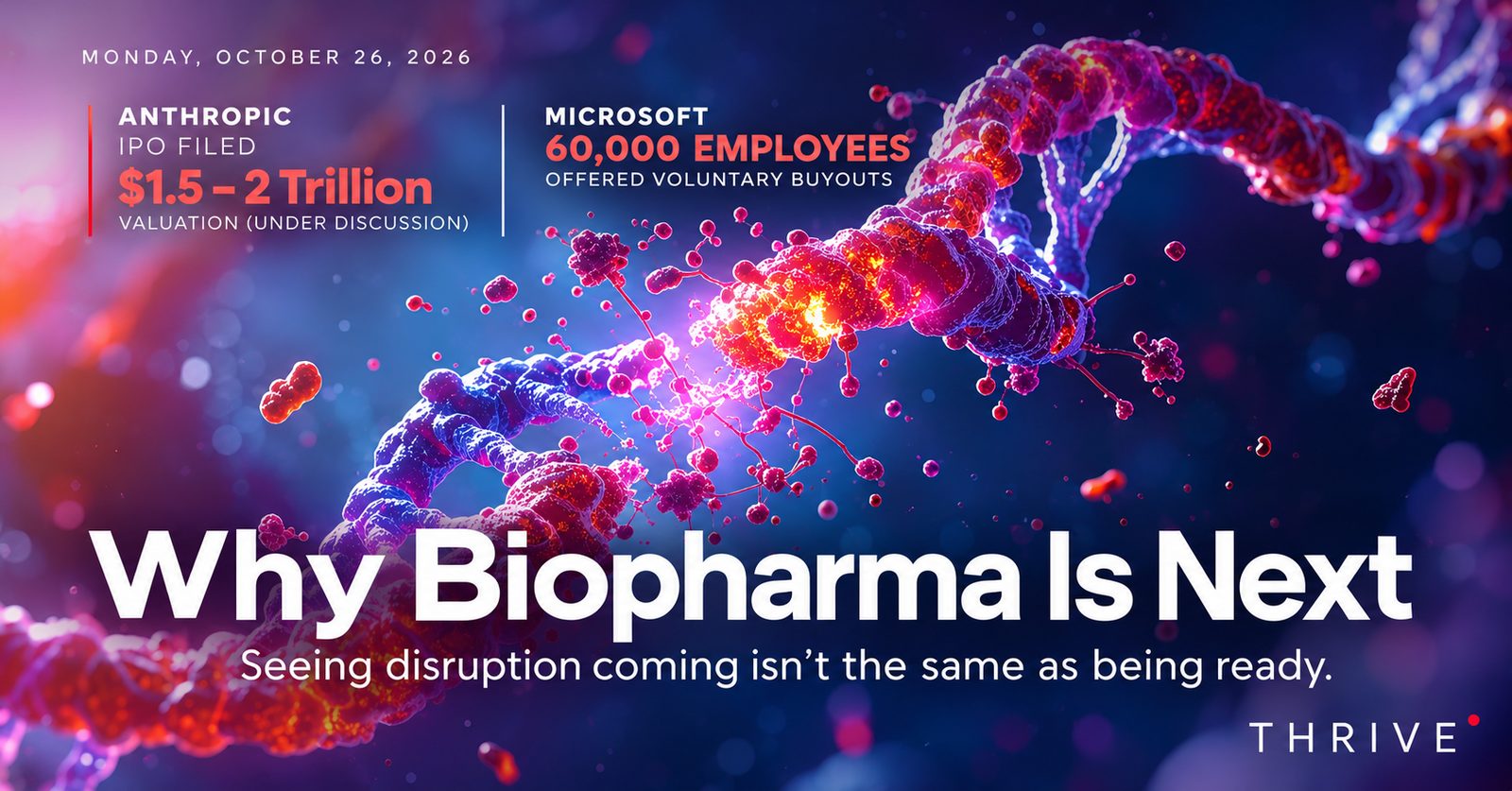
On Monday, October 26, Anthropic filed to go public, with a valuation of $1.5 trillion to $2 trillion reported to be under discussion. The same day, Microsoft offered voluntary exit packages to about 60,000 eligible employees, roughly 27% of its workforce.
One is a story of extraordinary expectations of future value from a five-year-old AI company. The other is a story of an established technology leader redesigning its cost base while it invests heavily in AI. Together they show the speed at which capital and talent are being reorganized.
The obvious question is whether Microsoft missed AI. It did not; it helped create the AI era. Its distinctive role was to become a major accelerator of the modern AI boom by contributing research, financing OpenAI, building the computing infrastructure behind its models, and bringing AI into widely used business software. A more interesting question is why a company that helped create the AI boom still must radically reinvent itself for it. The answer is that even the companies shaping a technological revolution must continually rebuild the organizations and business models they built for the previous one.
Seeing a technology coming does not tell you what future it will create, which business models will succeed, and which will be disrupted. Forecasts, technology roadmaps, and innovation funnels all have a place. On their own, these tools are not enough to help leaders systematically examine how the technology might change who makes decisions, where value accumulates, which business models survive and which new ones will be created, which organizational capabilities become obsolete, and which new ones will become mission critical.
Biopharma: an entrenched model meets an unfamiliar future
Biopharma, in my view, should pay particular attention. Few industries combine such high levels of scientific sophistication with such deeply embedded operating and commercial assumptions: tightly regulated clinical-development and approval pathways, physician prescribing, payers as gatekeepers, and product launch as a clearly defined “d-day”. These systems have been refined over decades. Their very success can make fundamentally different models hard to imagine.
Yet the industry is bound to be fundamentally transformed, if not disrupted. The future of the industry will emerge from the convergence of rapidly advancing technologies. AI is already changing how companies discover and develop therapies. Add multi-omics, molecular diagnostics, robotics, continuous monitoring, programmable medicines, and connected care. The shift is not simply toward better drugs. It is toward a different model of medicine: from episodic diagnosis to earlier and more continuous detection; from broad treatment categories to increasingly personalized solutions; and from a prescription written at a single moment to treatment continually informed by a patient’s changing biology. For biopharma, this will change more than the product portfolio and time-to-market. Some of the biggest disruptions will be at the heart of the commercial model: when a patient becomes eligible for treatment, what evidence guides prescribing, who makes and influences the treatment decision, how therapies are paid for, and where value is created. Competitive advantage will depend increasingly on how well a therapy fits into interconnected systems of diagnostics, decision support, delivery, and monitoring.
Who makes the treatment decision?
Many launch strategies assume the physician is the principal treatment decision maker, with payers setting access conditions. What happens when AI-enabled diagnostics and decision support increasingly identify eligible patients, evaluate options, and shape the treatment recommendation, while clinicians remain accountable for care? Evidence strategy, guideline inclusion, workflow integration, and relationships with digital decision systems could become as consequential as traditional promotion.
What determines the value of a therapy?
Much of the industry’s commercial architecture still assumes revenue follows price, utilization, and market share. In plausible alternative futures, manufacturers could increasingly be paid for durable outcomes, verified over time. Personalized and potentially curative treatments make affordability, payment timing, evidence generation, and long-term performance inseparable from launch strategy. Launch becomes the start of a multiyear value demonstration.
What constrains growth, and who controls patient access?
For most conventional medicines, the central challenges are demand, coverage, and uptake. For certain individualized therapies, the limiting factors may instead be manufacturing, specialist-center capacity, diagnosis, care coordination, or delivery. Meanwhile, access routes are being redesigned: LillyDirect is one example of an established biopharma company experimenting with a more direct-to-patient experience, supported by independent care providers and dispensing partners. Disruption can come from newcomers, and from incumbents willing to challenge their own model.
No single therapy will follow all of these paths. They are structurally different possibilities, unfolding at different speeds across therapeutic areas. In THRIVE’s Launch Excellence 2035 work, we explored four alternative futures for the U.S. market. The purpose is to test whether today’s strategy can survive, and succeed, across several of them.
The danger of the old mental map
In a memorable account of his work, scenario-planning pioneer Peter Schwartz shares IBM’s decision to deprioritize personal computers as a cautionary tale. Around 1980 IBM projected total personal-computer sales over five years of 241,683 units. The market, by his account, sold roughly 25 million. How was it possible that the leading computer company at the time underestimated the market by a factor of over one hundred? Because IBM’s leadership saw its customer as the IT department, which needed big machines; a person wanting a box with 16K of memory was outside its imagination. The people who decided to treat PCs as a side business were the best mainframe people in the world, and that was the problem. They were following their old maps, and these maps had no room for a flourishing PC market. So, IBM invested lightly and outsourced the two elements that turned out to matter most: the chip to Intel and the operating system to Microsoft. In doing so, it ceded two of the most important sources of value in the emerging PC ecosystem. Forty-five years later, Microsoft is the incumbent in a radically changing industry.
The lesson endures: incumbents are vulnerable less because they underestimate emerging technologies than because they interpret them through the logic of the businesses they already know.
Microsoft is no IBM; it is investing aggressively in the very technology reshaping its market. The parallel is subtler, and more important for biopharma. Deep expertise in the current system rarely comes with the imagination to picture the next one.
From imagining futures to acting on them
No forecast solves this. Anticipation without action creates well-informed organizations that still react too late or too haphazardly. Action built around a single forecast creates a different risk: commitment to a future that may never arrive. Leaders need the capacity to hold fundamentally different futures in view and to make deliberate choices as the evidence changes.
We call that discipline THRIVE Futures Architecture™. It connects strategic imagination with decisions and action: mapping the industry ecosystem; developing structurally distinct futures; stress-testing today’s strategy for vulnerabilities and upside; identifying no-regret moves and scenario-contingent bets; and monitoring early-warning signals that trigger changes in decisions and investment. The result is a living architecture that leadership teams, boards, and investors keep using.
For biopharma leaders, three questions are worth asking now:
- Which assumptions about who decides, who pays, and who controls patient access would most threaten our strategy if they changed?
- Where would our pipeline, launch plans, and investments be vulnerable, or unexpectedly advantaged, under fundamentally different futures?
- Which moves should we make now, and what early signals should prompt us to accelerate, change course, or stop?
Don’t be surprised by the future. Shape it.

Eliette Krakora is the Founder and CEO of THRIVE, specializing in launch excellence and strategic decision-making under uncertainty. About THRIVE

Read and share online:
thrive-co.com/insights/why-biopharma-is-next/
[email protected]
© 2026 THRIVE Consulting LLC. All rights reserved.